
Case Studies
Case Study: Ignition
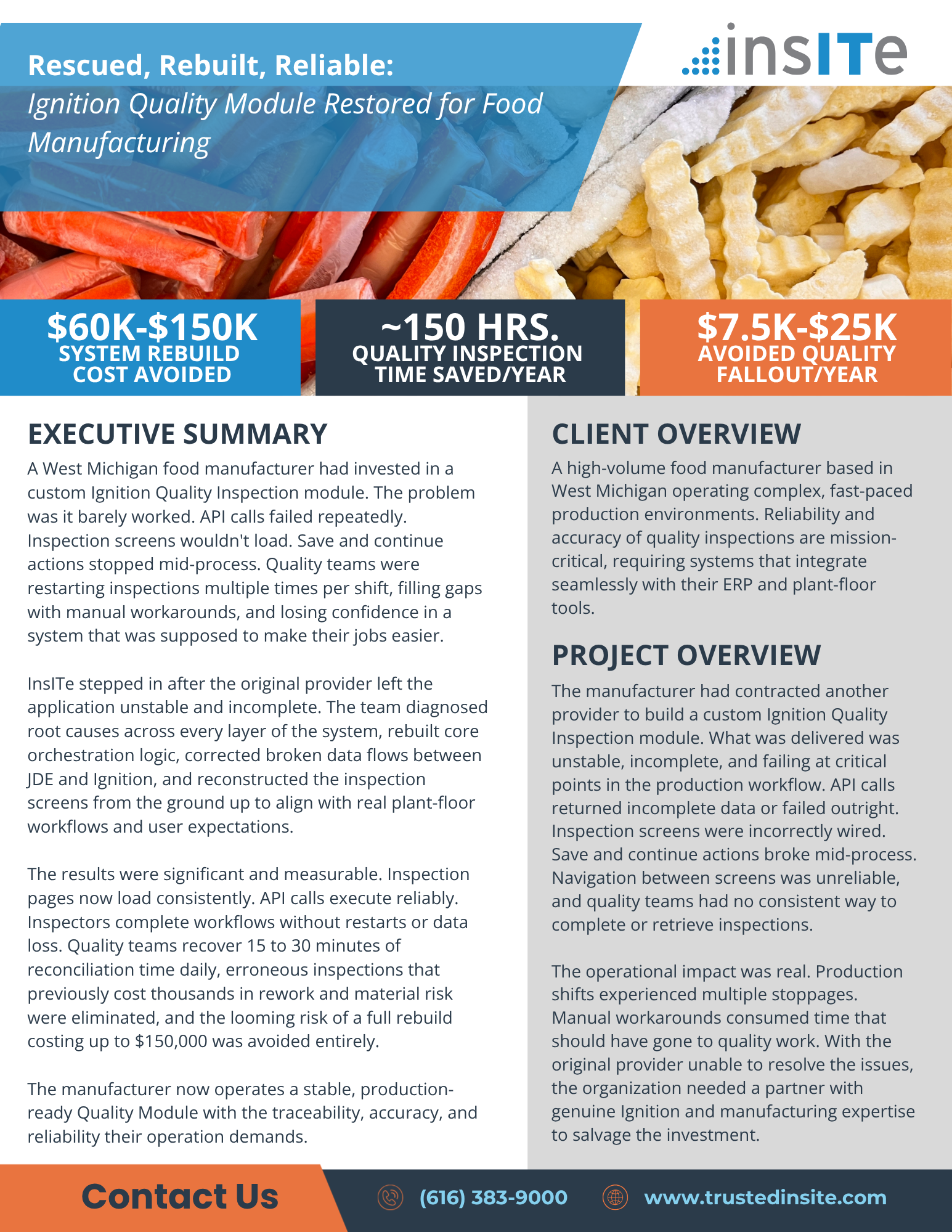
A West Michigan food manufacturer had invested in a custom Ignition quality inspection module, but the system barely worked. API calls failed, inspection screens wouldn’t load, and save actions dropped mid process, forcing quality teams to restart inspections multiple times a shift and rely on manual workarounds.
–
InsITe stepped in after the original developer left the application unstable and incomplete. The team diagnosed root causes across every layer of the system, rebuilt the core orchestration logic, corrected the data flow between JDE and Ignition, and reconstructed the inspection screens to match real plant floor workflows.
–
To see how InsITe helped this manufacturer avoid a $60,000 to $150,000 system rebuild while recovering up to 200 hours of inspection time a year, download the case study at the link below!
Case Study: BC Job Costs Project
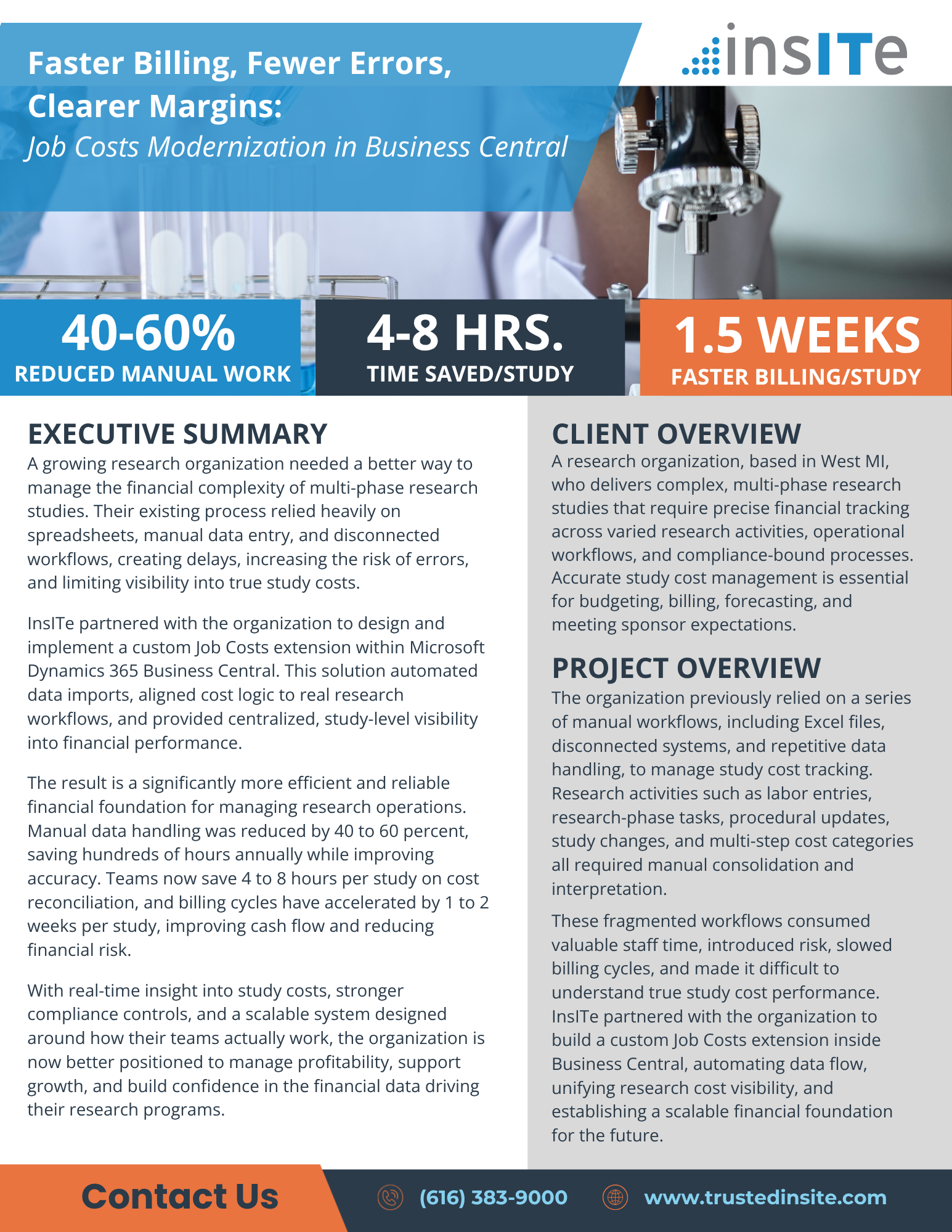
A growing West Michigan research organization needed a better way to manage the financial complexity of multi-phase research studies. Their process relied heavily on spreadsheets, manual data entry, and disconnected workflows, creating delays and limiting visibility into true study costs.
–
InsITe partnered with the organization to design and implement a custom Job Costs extension inside Microsoft Dynamics 365 Business Central, automating data imports, aligning cost logic to real research workflows, and providing centralized, study level visibility into financial performance.
–
To see how InsITe helped this organization reduce manual data handling by 40 to 60 percent while accelerating billing cycles by 1 to 2 weeks per study, download the case study at the link below!
Case Study: ERP Optimization
A West Michigan food manufacturer had invested in a custom Ignition quality inspection module, but the system barely worked. API calls failed, inspection screens wouldn’t load, and save actions dropped mid process, forcing quality teams to restart inspections multiple times a shift and rely on manual workarounds.
–
InsITe stepped in after the original developer left the application unstable and incomplete. The team diagnosed root causes across every layer of the system, rebuilt the core orchestration logic, corrected the data flow between JDE and Ignition, and reconstructed the inspection screens to match real plant floor workflows.
–
To see how InsITe helped this manufacturer avoid a $60,000 to $150,000 system rebuild while recovering up to 200 hours of inspection time a year, download the case study at the link below!

Case Study: Mandrel Math
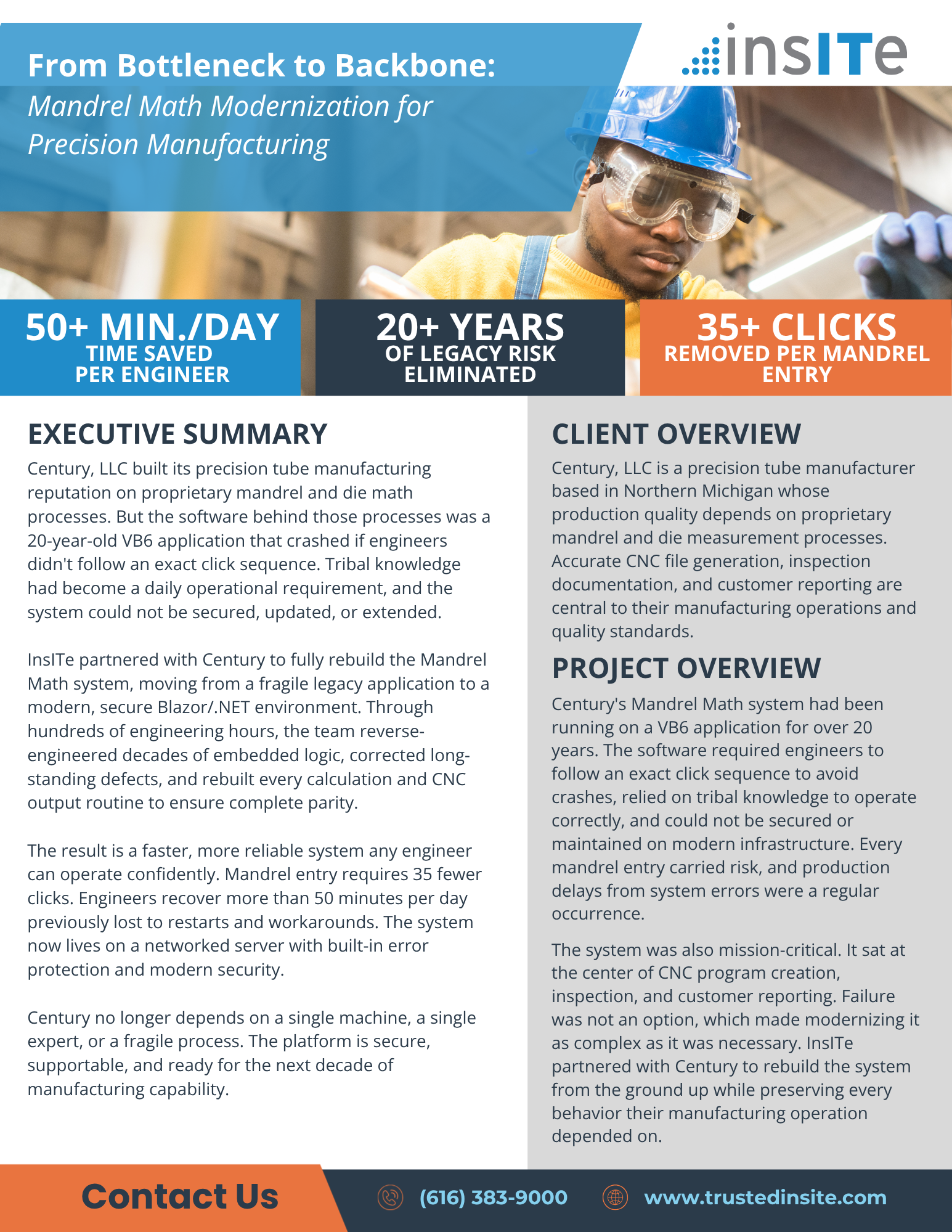
A precision tube manufacturer in Northern Michigan built its reputation on proprietary mandrel and die math processes, but the software behind it was a 20 year old application that crashed if engineers didn’t follow an exact click sequence. Tribal knowledge had become a daily requirement, and the system could not be secured, updated, or extended.
–
InsITe partnered with the manufacturer to fully rebuild the Mandrel Math system in a modern, secure environment. The team reverse engineered decades of embedded logic, corrected long standing defects, and rebuilt every calculation and CNC output routine to ensure complete parity with the original system.
–
To see how InsITe helped this manufacturer remove 35 clicks per mandrel entry and recover more than 50 minutes a day per engineer, download the case study at the link below!
Case Study: Audimute
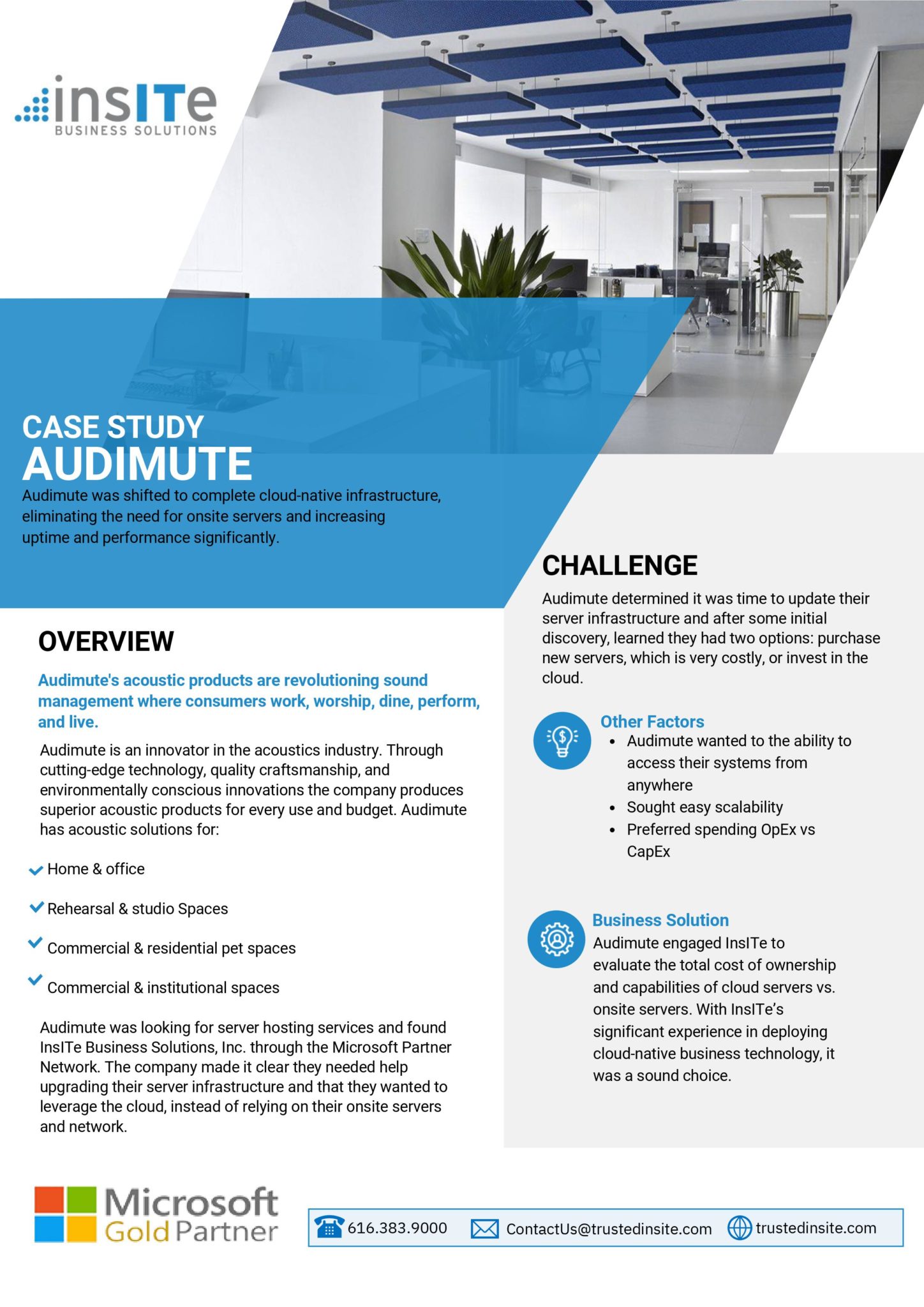
Audimute determined it was time to update their server infrastructure and after some initial discovery, learned they had two options: purchase new servers, which is very costly, or invest in the cloud.
Audimute was looking for server hosting services and found InsITe through the Microsoft Partner Network. The company made it clear they needed help upgrading their server infrastructure and that they wanted to leverage the cloud, instead of relying on their onsite servers and network.
InsITe was able to eliminate the need for onsite servers, shifting Audimute to complete cloudnative infrastructure.
To see how InsITe was able to reduce TCO by 20% over 3 years and over 25% in management costs for Audimute, download the case study at the link below!
Case Study: Salem Tube
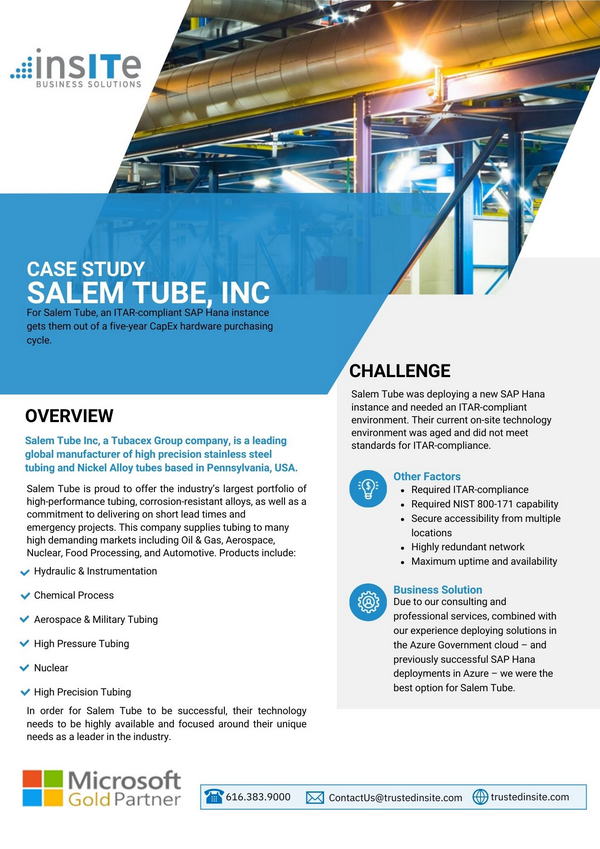
In order for Salem Tube to be successful, their technology needs to be highly available, secure, and focused around their unique needs as a leader in the industry.
InsITe provided the Azure Government subscription and configured the Azure Virtual Machines, Azure Virtual Networks, and connectivity, as well as Azure Backups to create a complete hosted environment for their SAP Hana application.
Click Below to see how we were able to accomplish…
- 100% ITAR Compliant SAP environment
- NIST 800-171 Capability
- Complete Remote Security
- Highly Redundant and Available Infrastructure
Case Study: Novo Building Products
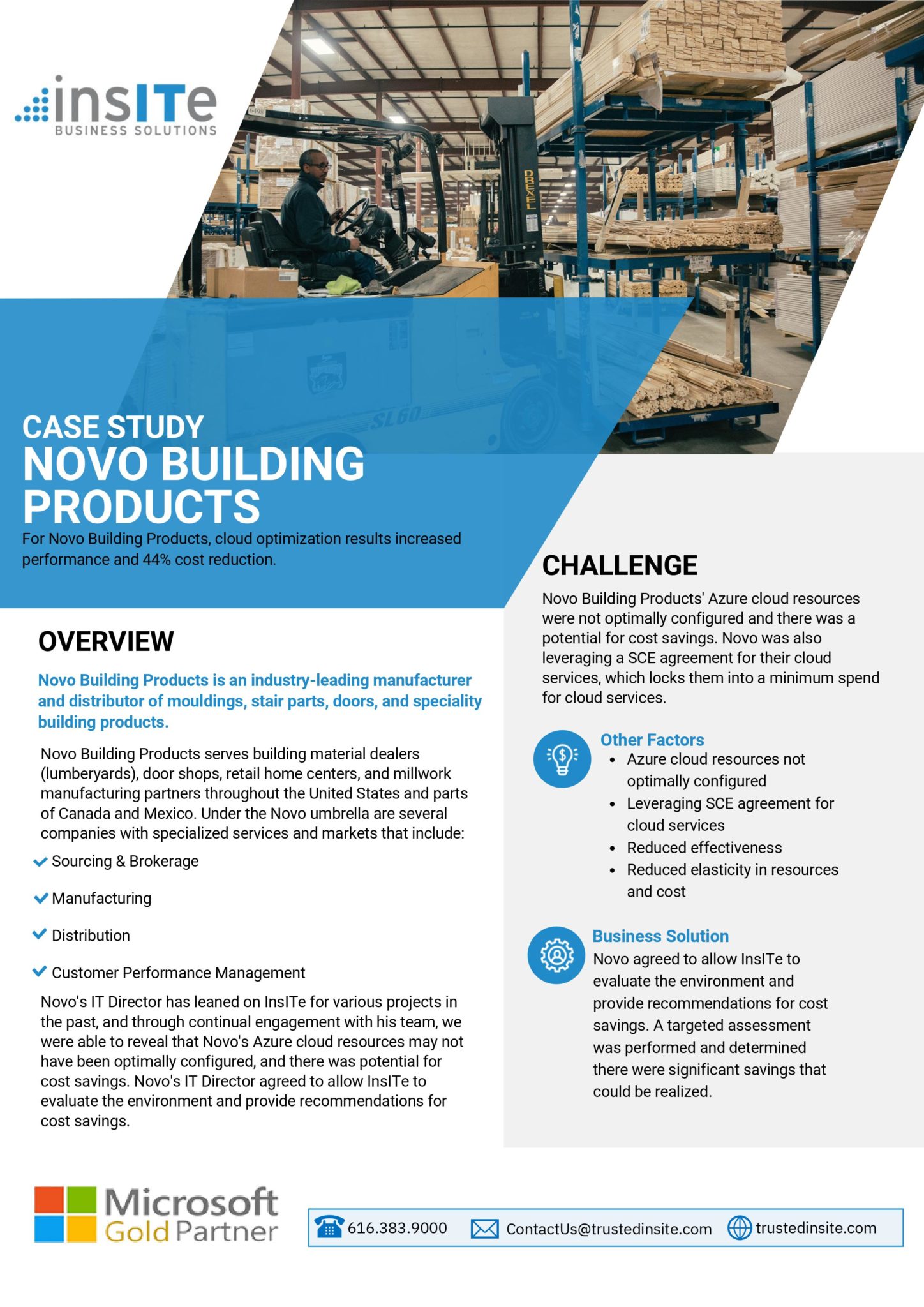
Novo Building Products’ Azure cloud resources were not optimally configured and there was a potential for cost savings. Novo was also leveraging a SCE agreement for their cloud services, which locks them into a minimum spend for cloud services.
InsITe was able to perform a targeted assessment and measure Novo’s usage of each cloud resource, then compare the relative usage to the capacity of each resource.
To find out how InsITe reduced Novo’s cloud costs by 44% through targeted Azure optimizations, follow the link below!
Case Study: Gilda’s Club of Grand Rapids
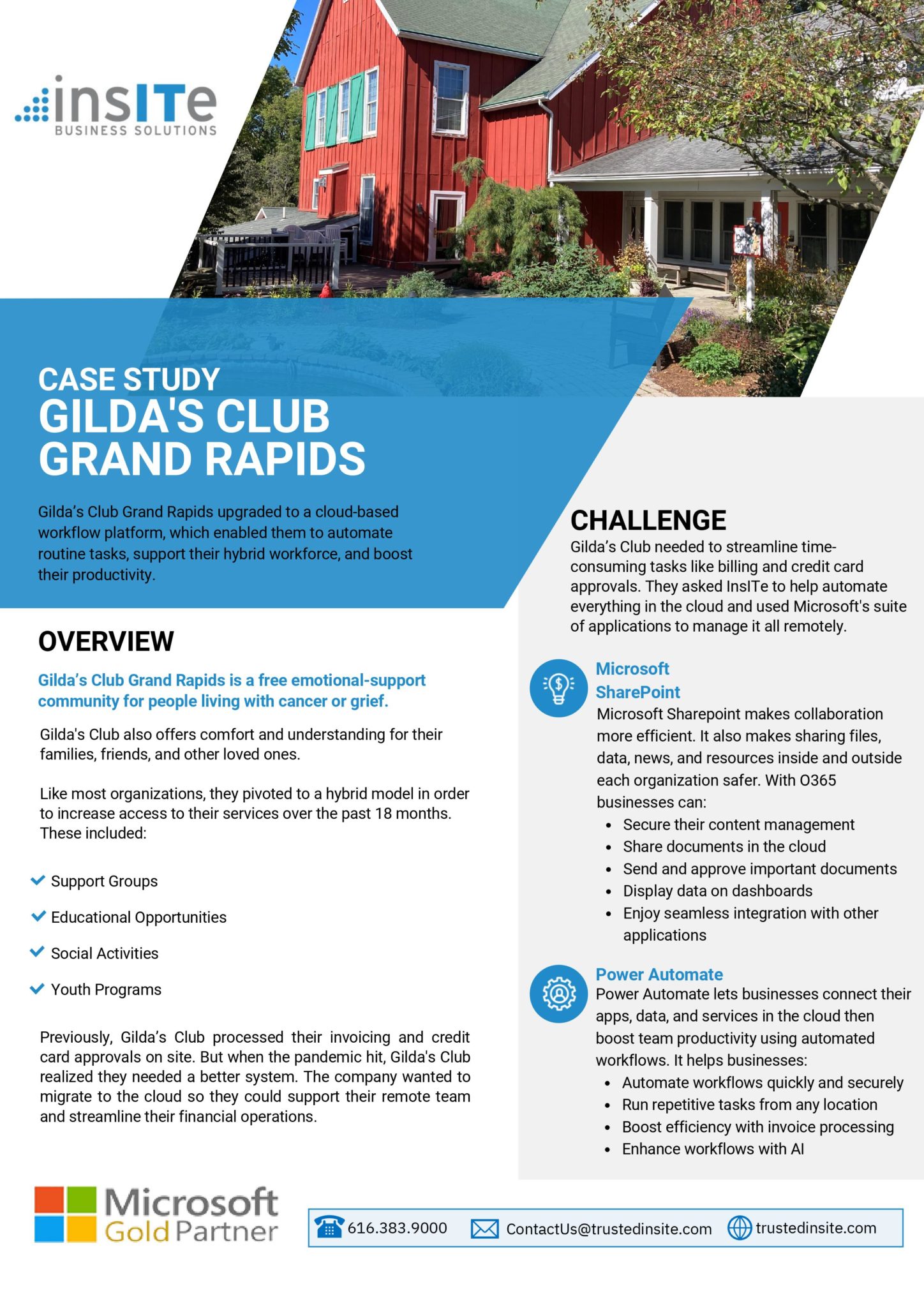
Gilda’s Club Grand Rapids’ invoicing process required them to be on-site to both approve credit cards and physically file every payment order. When the pandemic hit, they realized they needed a better system to support their hybrid workforce and streamline their financial operations.
InsITe helped Gilda’s Club migrate this process to the cloud. This not only automated a lot of their time-consuming manual tasks and saved them hours in credit card approvals but helped secure any sensitive data.
Find out how Gilda’s Club reduced hours of invoicing into mere minutes using Microsoft Azure and Microsoft’s Power Platform.
Common Questions About Getting Started with Technology Strategy
Q: Where should a manufacturer start with AI for productivity?
Start with clarity, not tools. The most common mistake is adopting AI tools before understanding where work actually slows down. A practical first step is identifying which tasks are repetitive, which decisions take too long, and where people spend time on low-value work. InsITe’s AI for Productivity Roadmap and companion Strategy Snapshot are designed to help teams do exactly that before making any tool or process decisions.
Q: What is a digital transformation roadmap and do manufacturers need one?
A digital transformation roadmap is a phased plan that sequences technology investments to match how an operation actually runs. For manufacturers, it typically covers IT/OT integration, data visibility, process connectivity, and team enablement. Without a roadmap, technology investments tend to accumulate without a clear direction, which creates cost, complexity, and frustration. InsITe’s Digital Transformation Roadmap gives manufacturers a practical framework to define success and make progress without disrupting production.
Q: How do manufacturers know if their cybersecurity program is strong enough?
Most manufacturers find that their security posture has gaps when something goes wrong. A better approach is a structured self-assessment that looks at identity controls, network security, device protection, backups, and incident response before a problem surfaces. InsITe’s Security Self-Check gives manufacturers a clear, pressure-free way to assess where they stand today and identify the highest-priority gaps to address first.
Q: What is the difference between IT security and OT security for manufacturers?
IT security protects business systems: email, data, user access, and cloud infrastructure. OT (operational technology) security protects the systems that run production: PLCs, SCADA systems, machine controls, and shop floor networks. Manufacturers with both environments face a convergence risk where a breach in one can affect the other. A strong security program addresses both layers with controls that are appropriate for each environment without slowing production.
Q: What does a practical IT and OT security framework look like for a small or mid-sized manufacturer?
For most SMB manufacturers, a practical framework starts with three things: knowing what you have (asset inventory), controlling who can access it (identity and access management), and having a tested plan for when something goes wrong (incident response). From there, the right compliance framework, whether NIST, CMMC, or another standard, can be layered in based on customer requirements and risk profile. InsITe’s Security & Compliance Roadmap walks through this sequence in a way that fits how manufacturers actually operate.
Q: How long does it take to implement an AI for productivity program?
It depends on where the organization starts and how much friction already exists in day-to-day work. Most teams can begin seeing time savings from targeted AI use cases within 30 to 90 days, particularly when they start with tools they already own, like Microsoft 365 Copilot, and focus on one or two high-friction workflows first. A phased approach that builds team confidence alongside capability tends to produce more durable results than a broad rollout.
Q: What should manufacturers look for in a technology partner for digital transformation?
Look for a partner with direct manufacturing experience, not just general IT expertise. The right partner understands production environments, OT systems, and the operational constraints that make manufacturers’ technology decisions different from other industries. They should be willing to start with your current state rather than prescribing a solution, provide end-to-end accountability across IT and OT, and communicate in business terms rather than technical jargon.