
Technology Roadmaps and Resources
The resources below are designed for organizations that are figuring out where to start, what to prioritize, and how to move forward without adding unnecessary risk or cost. Each one is free, practical, and built around how operations actually run.
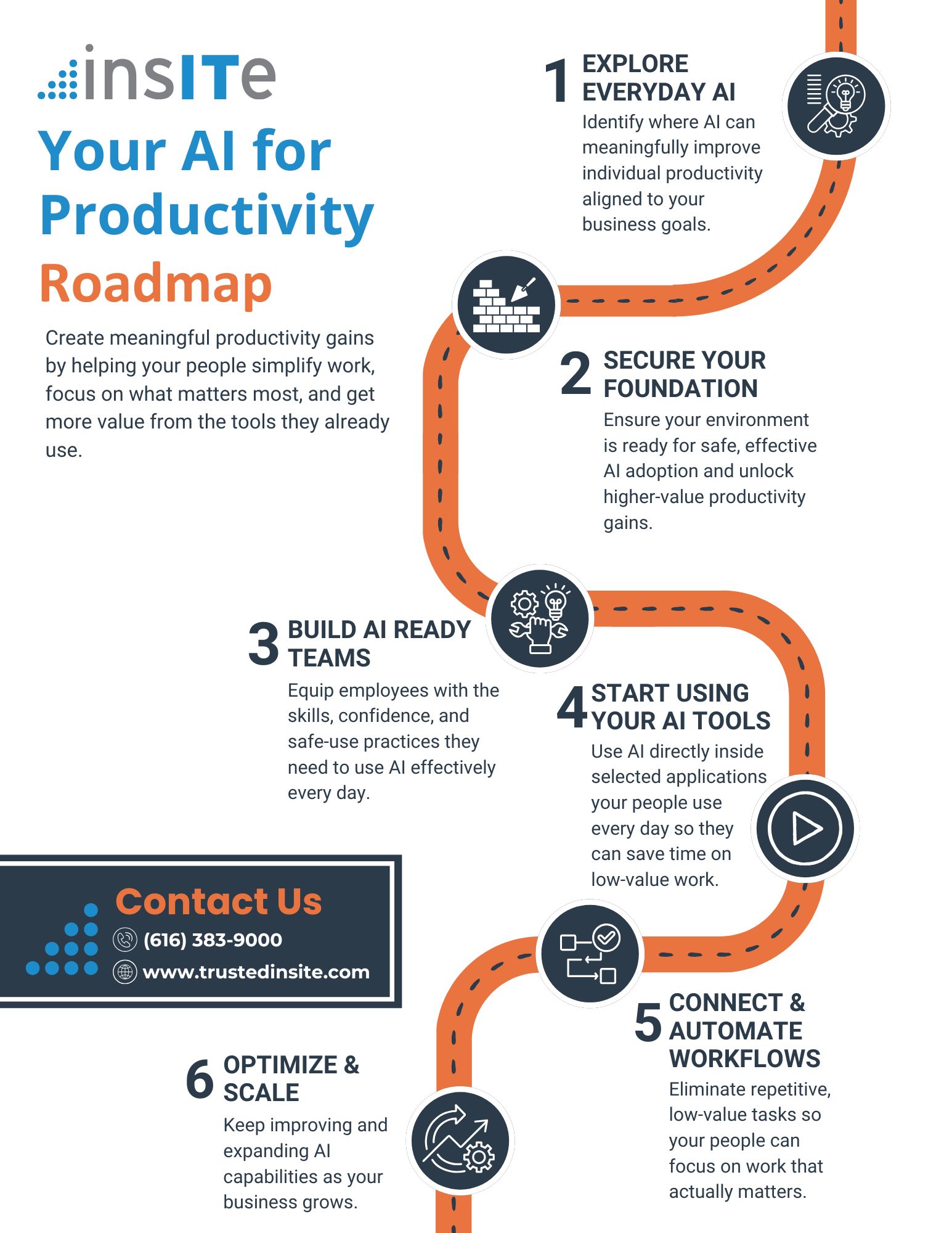
Your AI for Productivity Roadmap and AI for Productivity Snapshot
Most teams aren’t short on AI tools. They’re short on clarity about where to start.
This 6-step roadmap helps organizations identify where everyday AI can realistically reduce friction, give time back, and improve how work gets done, using the tools they already have. It walks through exploring where AI fits, securing the foundation for safe adoption, building team confidence, and scaling what works.
The companion AI for Productivity Strategy Snapshot helps you pinpoint your biggest sources of friction before making any tool or process decisions. It takes about 10 minutes and gives you a shared starting point for planning.
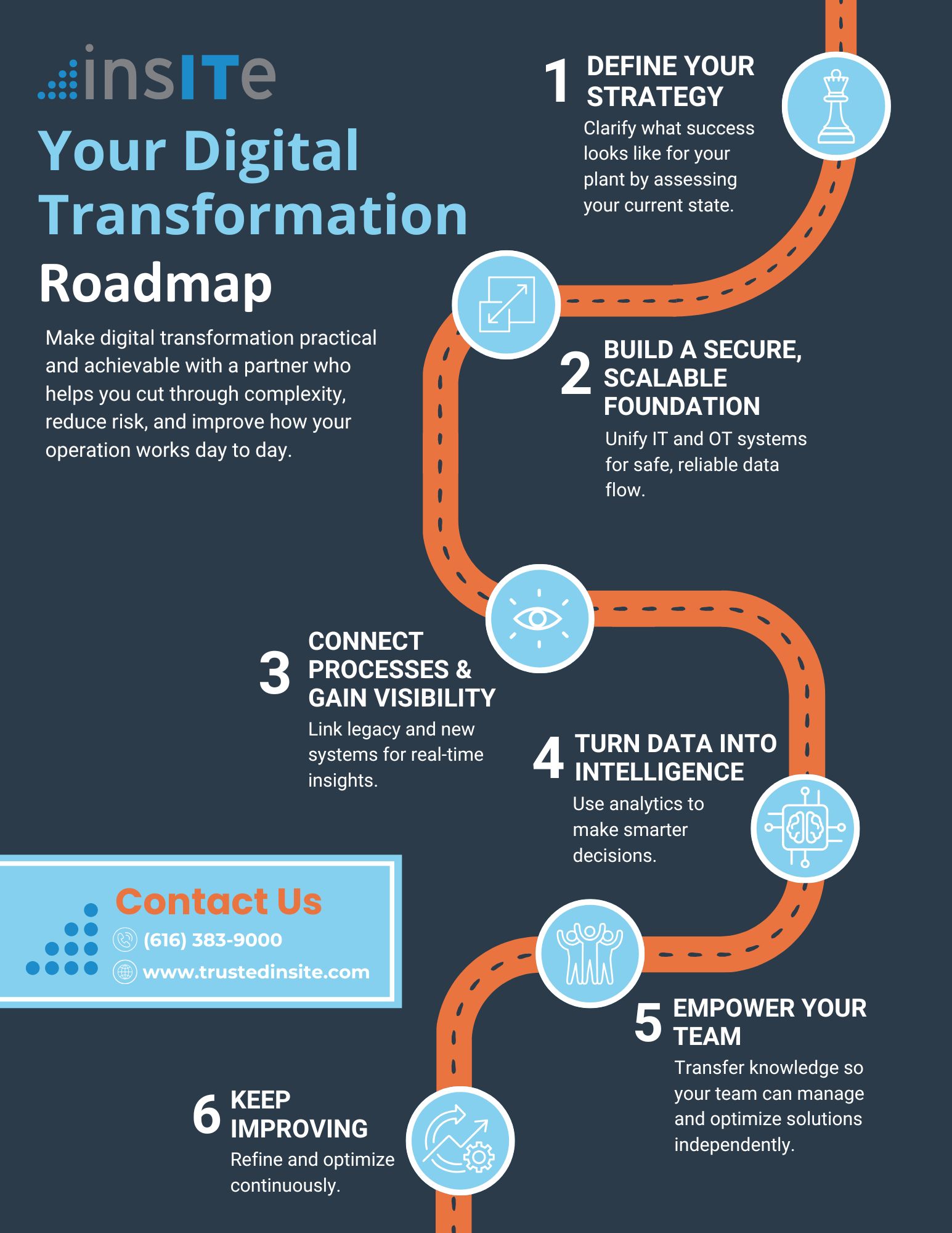
Your Digital Transformation Roadmap and Digital Transformation Snapshot
Digital transformation stalls when strategy comes after investment. This roadmap helps manufacturers get the sequence right.
The 6-step Digital Transformation Roadmap walks through defining success for your operation, building a secure and scalable IT/OT foundation, connecting processes for real-time visibility, turning data into actionable intelligence, and keeping progress moving after go-live. It’s designed for operations where legacy systems, mixed environments, and competing priorities make change feel harder than it should.
The companion Strategy Snapshot helps you clarify priorities and surface where progress feels fragile before committing to a direction. It’s a practical starting point for business leaders, IT directors, and operations teams who want alignment before investment.
Your Security & Compliance Roadmap and Security Self-Check
Manufacturers need security that protects the business without slowing production. That balance starts with knowing where you actually stand.
This 6-step Security & Compliance Roadmap walks through getting a clear picture of your current risks, strengthening your foundation, identifying the right framework for your operation, closing documented gaps, and building the habits that keep protections in place over time. It’s written for mixed IT and OT environments where compliance pressure and operational continuity both matter.
The companion Security Self-Check is a low-friction starting point. It helps you assess where controls may be missing or inconsistent, without complexity or pressure, so you can move forward with clarity instead of guesswork.

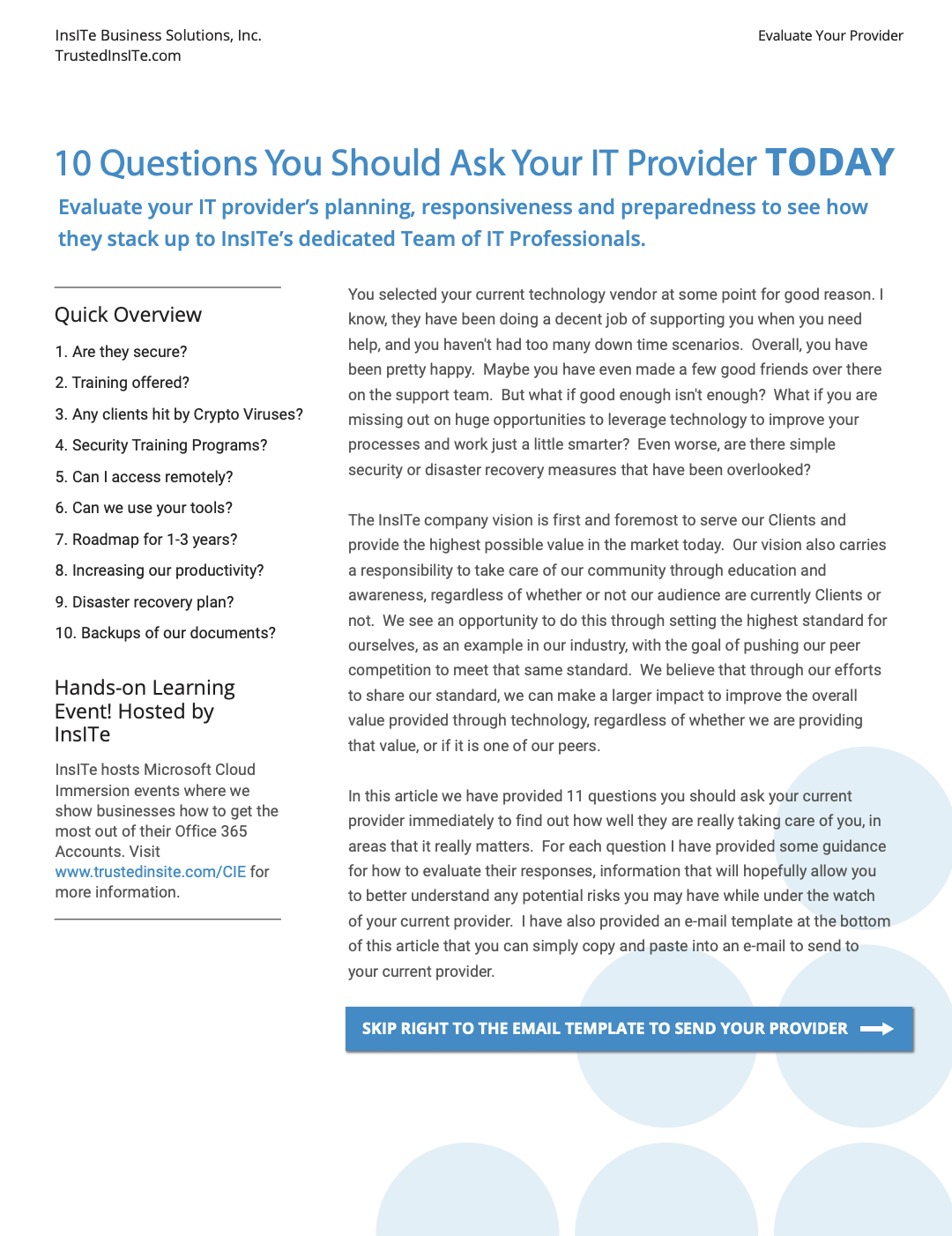
10 Questions You Should Be Asking Your IT Provider Today
This article provides 10 questions that evaluate how your technology partner is optimizing your technology investment and taking care of you in the areas that matter most. Each question contains guidance on how to evaluate your technology partner’s responses and any potential risks you should watch for. At the bottom of this article, you will find an e-mail template you can copy and paste and send to your current provider for them to answer.
What You Should Know Before Migrating to the Cloud
The purpose of this brief guide is to provide business owners and decision makers a clear, easy-to-digest explanation of just what cloud computing is and the ways it improves how we do business. Tips are also provided for those who are seeking a cloud solutions specialist.
Regardless of who you choose for cloud-based solutions, it is never a decision you want to rush into without the proper analysis and strategy. By the end of this guide, you will have a better understanding of the cloud and the questions to ask when it comes to how cloud services can apply to your business.
InsITe’s Practical Security Defense Guide
Global attackers are targeting all organizations, large and small. And despite any intentions to store all data onsite, the reality is every organization’s employees are transmitting or storing organizational data externally on a regular basis; they simply may not know how or when.
In order to help recognize and prevent associated security breaches, our team of experienced security engineers have identified the top threats, and have provided tips to prevent breaches and vulnerabilities caused by these threats within this guide. Download this practical security defense guide to help you protect yourself today.
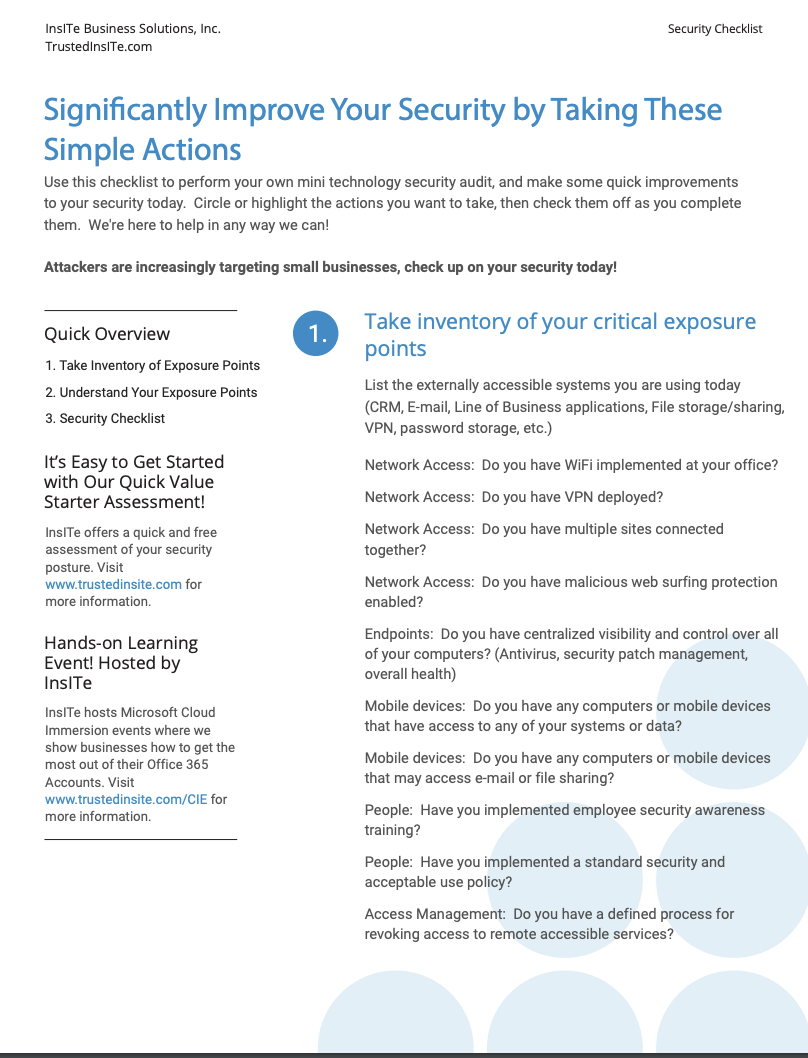
Security Check List
Use this checklist to perform your own mini technology security audit, and make some quick improvements to your security today. Circle or highlight the actions you want to take, then check them off as you complete them.
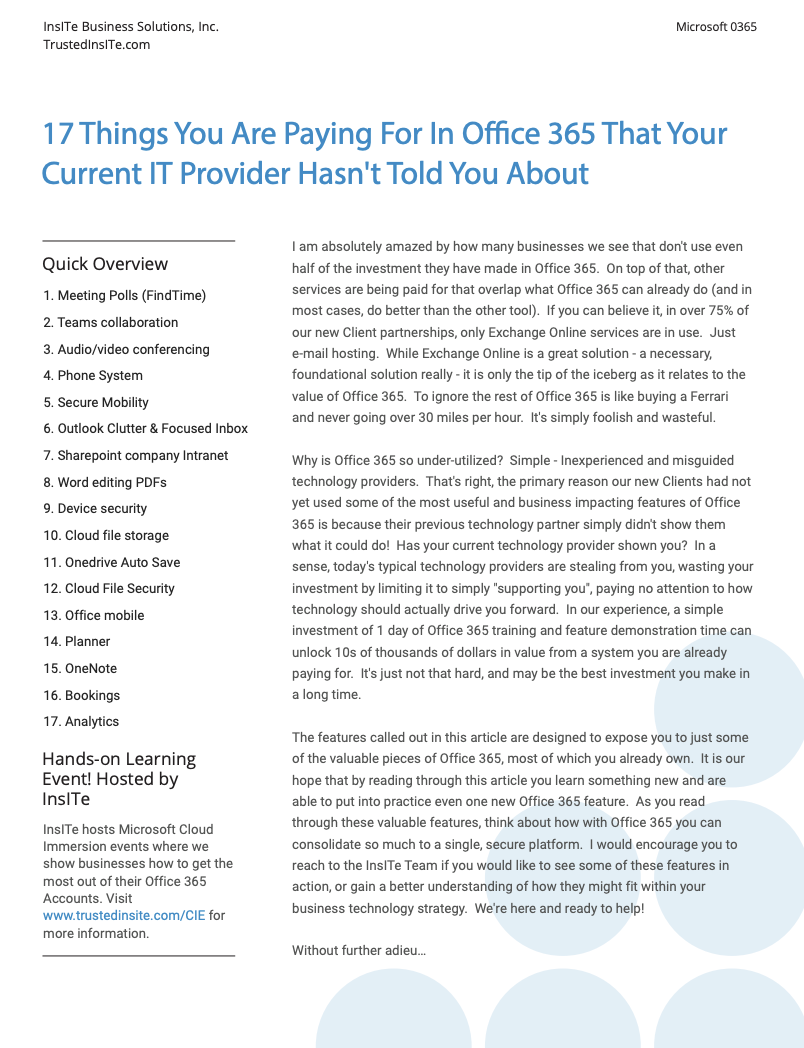
17 Things You Are Missing in Office 365
Why is Office 365 so under-utilized? Inexperienced and misguided technology providers. That’s right, the primary reason our new clients had not yet used some of these useful and business-impacting features of Office 365 is that their previous technology partner simply didn’t show them! Has your current technology provider shown you?
In our experience, a simple investment of one day of Office 365 training and feature demonstration time can unlock tens of thousands of dollars in value from a system you are already paying for.
The features called out in this article are designed to expose you to just some of the valuable pieces of Office 365, most of which you already own.
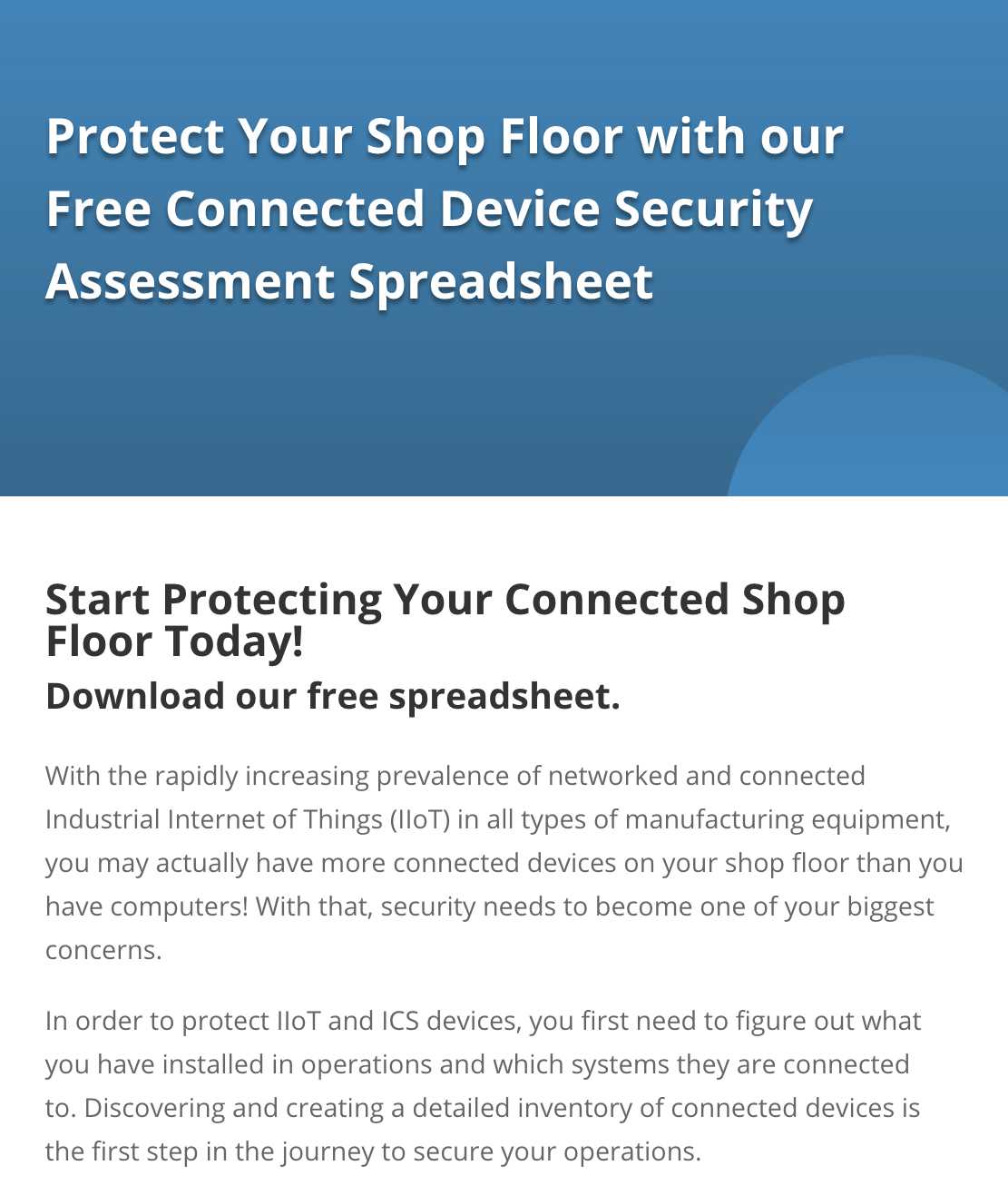
Connected Device Security Assessment Spreadsheet
Each device on your network can pose a potential threat to your entire network. And if your business is not secure, hackers can to get into every single device connected internally and control it. Before you know it, production is at a standstill.
In order to protect your connected devices, it’s important to assess which ones have been installed in operations and which systems they are connected to. One way to do that is by creating a detailed inventory list of your connected devices.
Download our free, easy-to-use Connected Device Security Assessment Spreadsheet that will help you list and assess all the devices you have, secure your operations, and identify possible threats that could come up.
Check out our blog to learn more about this topic!
Common Questions About Getting Started with Technology Strategy
Q: Where should a manufacturer start with AI for productivity?
Start with clarity, not tools. The most common mistake is adopting AI tools before understanding where work actually slows down. A practical first step is identifying which tasks are repetitive, which decisions take too long, and where people spend time on low-value work. InsITe’s AI for Productivity Roadmap and companion Strategy Snapshot are designed to help teams do exactly that before making any tool or process decisions.
Q: What is a digital transformation roadmap and do manufacturers need one?
A digital transformation roadmap is a phased plan that sequences technology investments to match how an operation actually runs. For manufacturers, it typically covers IT/OT integration, data visibility, process connectivity, and team enablement. Without a roadmap, technology investments tend to accumulate without a clear direction, which creates cost, complexity, and frustration. InsITe’s Digital Transformation Roadmap gives manufacturers a practical framework to define success and make progress without disrupting production.
Q: How do manufacturers know if their cybersecurity program is strong enough?
Most manufacturers find that their security posture has gaps when something goes wrong. A better approach is a structured self-assessment that looks at identity controls, network security, device protection, backups, and incident response before a problem surfaces. InsITe’s Security Self-Check gives manufacturers a clear, pressure-free way to assess where they stand today and identify the highest-priority gaps to address first.
Q: What is the difference between IT security and OT security for manufacturers?
IT security protects business systems: email, data, user access, and cloud infrastructure. OT (operational technology) security protects the systems that run production: PLCs, SCADA systems, machine controls, and shop floor networks. Manufacturers with both environments face a convergence risk where a breach in one can affect the other. A strong security program addresses both layers with controls that are appropriate for each environment without slowing production.
Q: What does a practical IT and OT security framework look like for a small or mid-sized manufacturer?
For most SMB manufacturers, a practical framework starts with three things: knowing what you have (asset inventory), controlling who can access it (identity and access management), and having a tested plan for when something goes wrong (incident response). From there, the right compliance framework, whether NIST, CMMC, or another standard, can be layered in based on customer requirements and risk profile. InsITe’s Security & Compliance Roadmap walks through this sequence in a way that fits how manufacturers actually operate.
Q: How long does it take to implement an AI for productivity program?
It depends on where the organization starts and how much friction already exists in day-to-day work. Most teams can begin seeing time savings from targeted AI use cases within 30 to 90 days, particularly when they start with tools they already own, like Microsoft 365 Copilot, and focus on one or two high-friction workflows first. A phased approach that builds team confidence alongside capability tends to produce more durable results than a broad rollout.
Q: What should manufacturers look for in a technology partner for digital transformation?
Look for a partner with direct manufacturing experience, not just general IT expertise. The right partner understands production environments, OT systems, and the operational constraints that make manufacturers’ technology decisions different from other industries. They should be willing to start with your current state rather than prescribing a solution, provide end-to-end accountability across IT and OT, and communicate in business terms rather than technical jargon.